

Running multiple online stores is no longer unusual. For many growing brands, it’s the default.
Merchants launch separate storefronts for different regions, markets, currencies, or sales strategies. Some operate multiple Shopify stores. Others combine Shopify and WooCommerce. While this unlocks growth, it also introduces a serious operational challenge:
How do you accurately track inventory and demand across all stores at once…?
The Multi-Store inventory problem
Most eCommerce platforms provide decent reporting at the individual store level, but the moment a business runs more than one store, inventory visibility really starts to break down.
Common issues we hear from customers (before using Metorik):
Sales and inventory data is split across platforms and doesn’t talk
Impossible to get a unified view of product performance
Complex, clunky, manual spreadsheets to estimate stock and repurchasing
Items show as out of stock in one store while inventory sits unused in another
This makes inventory planning reactive instead of strategic, especially when demand is changing quickly.
Why Multistore Stock Velocity is the missing piece
Inventory counts alone don’t tell the full story. What many rapidly-growing sellers actually need is stock velocity – how fast a product is selling relative to available inventory, and most importantly, how many days left before we run out.
Stock velocity answers critical operational questions:
Which SKUs are selling fastest across all stores?
How many days of stock remain at the current sales rate?
Which products need to be reordered first?
Where is inventory over- or under-allocated?
For multi-store businesses, this insight must be cross-store and cross-platform to be useful.
Introducing the Multistore Stock Velocity Report in Metorik
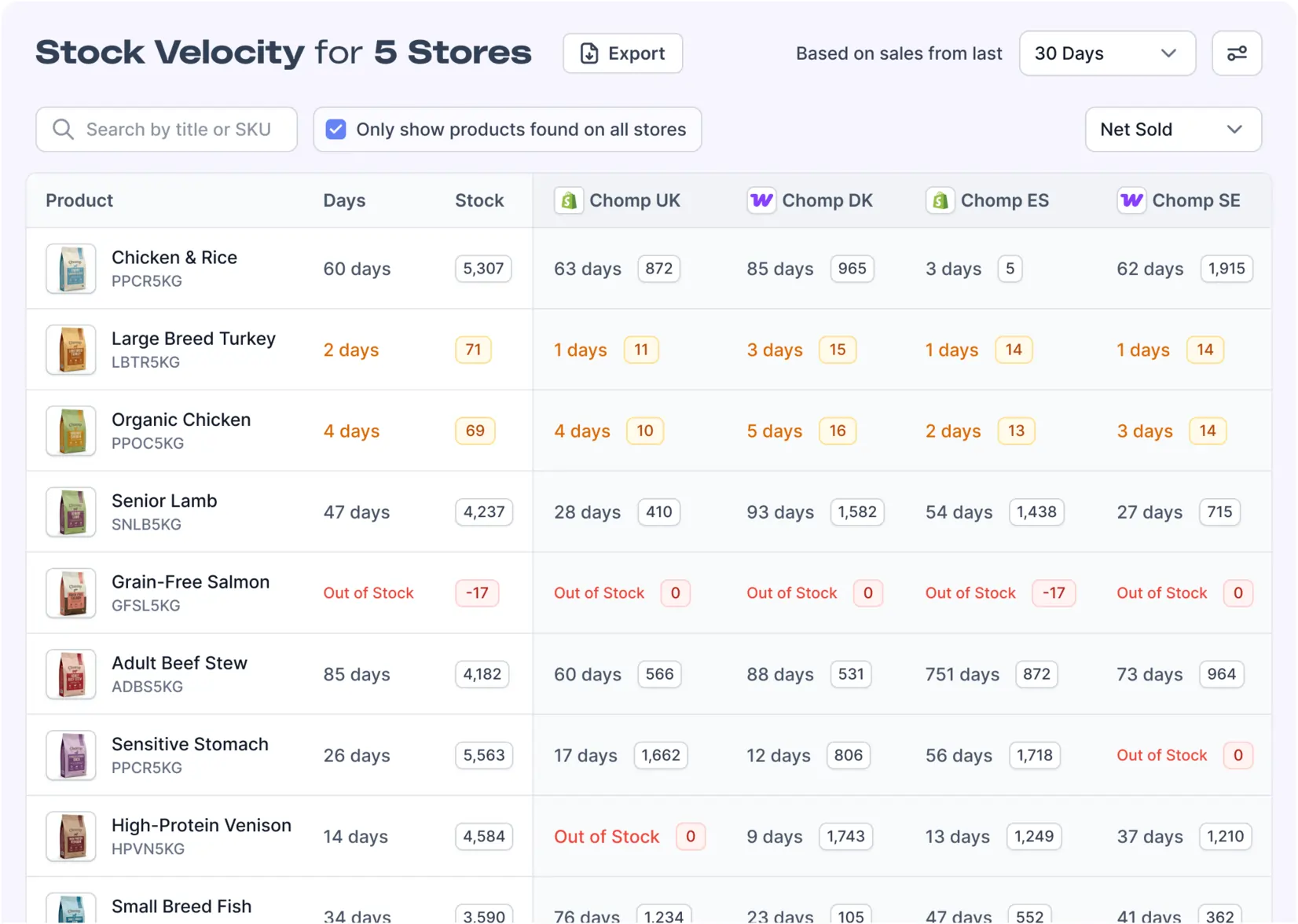
Metorik’s new Multistore Stock Velocity report is built specifically for multi-store eCommerce sellers.
It joins products by SKU across multiple stores, including combined data from Shopify and WooCommerce, to provide a single, accurate view of demand and inventory.
The report shows:
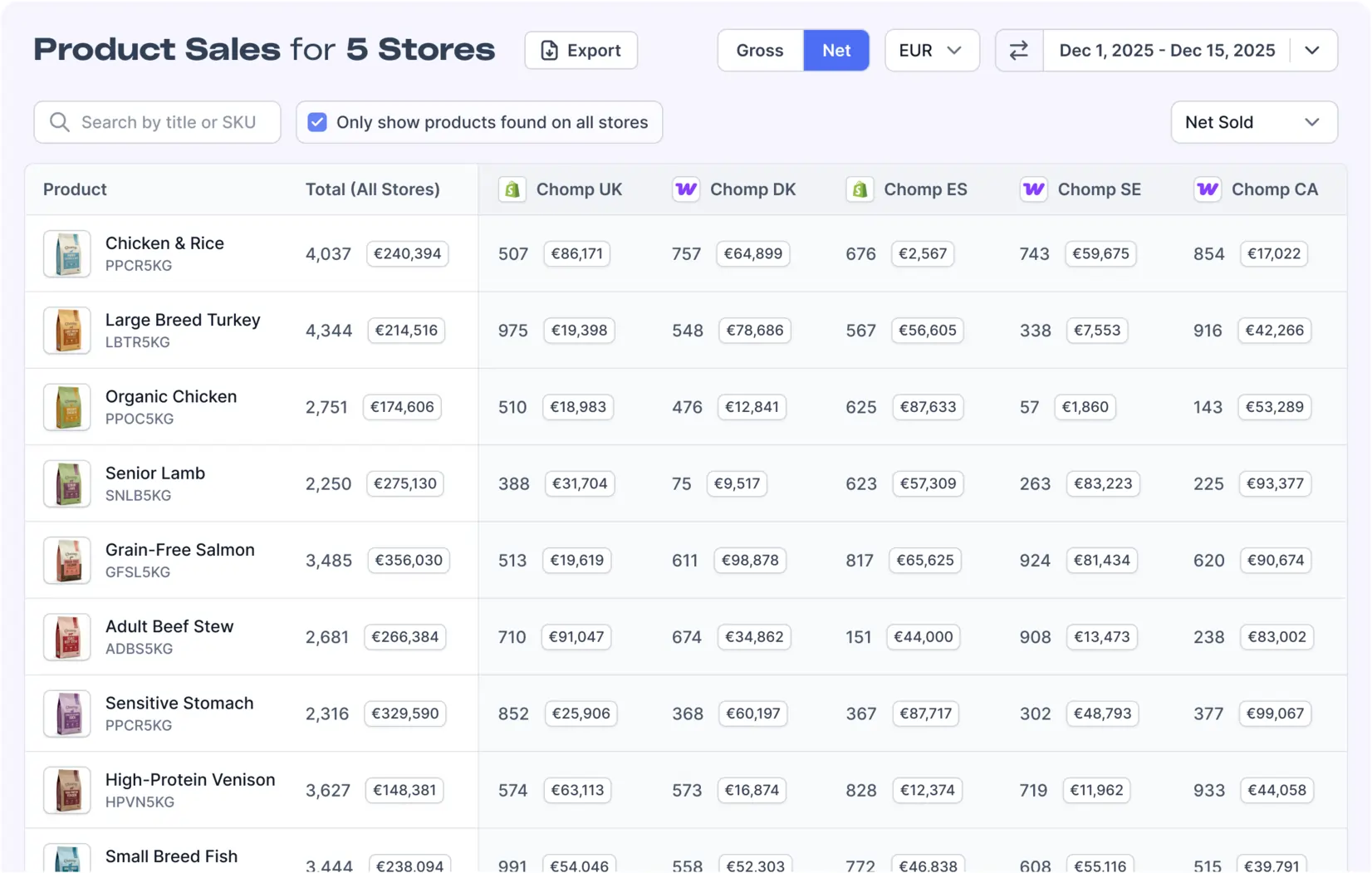
Total units sold across all connected stores
Combined inventory levels by SKU
Estimated days of stock remaining
Sales velocity based on the last 7, 15, 30, 60, 90, 180 or 365 days
This allows sellers to evaluate product performance across their entire operation, not one store at a time.
Built for how multi-store commerce actually works
Stock Velocity isn’t about predicting the future with perfect accuracy. It’s about helping operators make better decisions with the data they already have. By grounding inventory planning in real sales velocity, multi-store sellers can:
Reduce stockouts and overselling
Plan replenishment earlier and with more confidence
Identify fast-moving and slow-moving products
Eliminate manual reporting and spreadsheets
“We built Multistore Stock Velocity because sellers need a trustworthy view of demand. Joining sales and inventory by SKU across both Shopify and WooCommerce stores removes guesswork or combining exports into spreadsheets, and gives our customers clarity.”
Designed for Shopify and WooCommerce Sellers
Many analytics and inventory tools focus on a single platform. Metorik’s Stock Velocity report is designed for businesses running multiple stores across different platforms.
It works for:
Brands operating multiple Shopify stores
Sellers combining Shopify and WooCommerce
Multi-brand or multi-region operations
Teams that need operational reporting, not just analytics
All data lives inside Metorik’s Multistore dashboard, alongside the top level sales, costs and profit metrics sellers already rely on.
Customer Feedback
“One thing is already very clear: I’ve clearly been buying blind for the past 6 months. With this new feature, I can finally purchase properly – the way it should be done.” Metorik Customer from Sweden 🇸🇪
A clearer way to manage multi-store inventory
As multi-store commerce becomes more common, fragmented inventory data becomes a real risk. Metorik’s Multistore Stock Velocity report helps bring that data together so sellers can act earlier, plan better, and stay ahead of demand.
The Multistore Stock Velocity report is available now inside Metorik’s Multistore dashboard.

-1549438730.jpg)